archive
Osmosis (Thread)
As the DeFi industry is on a continuous growth, following its exponential TVL growth, so does the need of Automated Market Makers as the backbone.
Enter Osmosis! The advanced AMM protocol built using @cosmos SDK that allows developers to design, build, and deploy their own customized AMM.

In larger perspective, Osmosis is an independent chain in the Cosmos ecosystem. It does rely on Cosmos’s blockchain but has its own validators, and leverages Cosmos’ Inter-Blockchain Communication protocol.
Why Osmosis?
-
Built with the Cosmos SDK – EVM compatible
-
DEX and AMM for Cosmos ecosystem with fees under than $1.00
-
Cross-chain native at its foundation
-
Superfluid staking – staking and liquidity provider simultaneously
-
AMM as serviced infrastructure – providing the ability for creator to simply define bonding curve value function
Osmosis is a product of @osmolabs founded by @sunnya97 and @dogemos. Sunny Aggrawal was a developer in Cosmos and Tendermint Core, currently he is also the co-Founder of @SikkaTech. Josh Lee was a member of Tendermint Core and the founder of @chainapsis.
Initially, the project began with the merger of @osmosis and @chainapsis. Osmosis being the DEX and AMM for the Cosmos ecosystem, while Chainapsis provides the cold wallet – Keplr – that facilitates the whole project.
Osmosis is a fair launch with the only funding being ICO. The project successfully raised $21M and attracted investors such as @paradigm (lead), @robotventures, @NascentVenture, @stablekwon, @Figment_io, and Ethereal Ventures.
Do note that Heterogeneity and Sovereignty are two core dogma of the Cosmos ecosystem!
With IBC enabled in the DEX, $OSMO aims for a plethora of projects or protocols alike regardless of their blockchain rather than being a one-size-fits-all approach.
Nothing in the underlying structure of Osmosis is hard-coded, everything from swap fees to token weight are parameters in each liquidity pool. With this in mind, the dynamic fees adapt to moments of high volatility and work to mitigate impairment losses for LP.
Given that there are no perfect structure to be the best in any DEX, $OSMO focuses on three pillars:
Shared Security
Adding complexities or features to Cosmos finding the solution to the coexistence of permissionless innovation and incentive alignment. Thus, the shared security would allow zones to delegate their consensus security to Cosmos Hub validators.
Credible Neutrality
The value of shared security is dependent on the trust in Cosmos credible neutrality. To be the best platform, the hub should not try to pre-define the winners but instead minimize fears that might compete with applications that are trying to build on top of it.
Staking Derivatives
The team predicted that $ATOM will likely be the most popular pair within $OSMO. By enabling staking derivatives, staked ATOM would flow to other chains to be a core asset while still accruing rewards from the hub and other shared security chains.
Bottom-line, Osmosis is not a module on the Cosmos hub, it will be a chain of Cosmos. It is a Hub AMM.
$OSMO Tokenomics
The initial supply of OSMO is 100 million which is split evenly between Fairdrop recipients and strategic reserve. The governance will have the opportunity to direct the core tokenomics, which could be revised based on consensus. In fact, the team encourages this!
Under the initial token model, new tokens would be released based on a “thirdening” schedule – similar to $BTC halving. The token issuance is decreased by half every four years with each release being daily (epoch is daily). Summing up to 76% inflation rate cut by ⅓ per year.
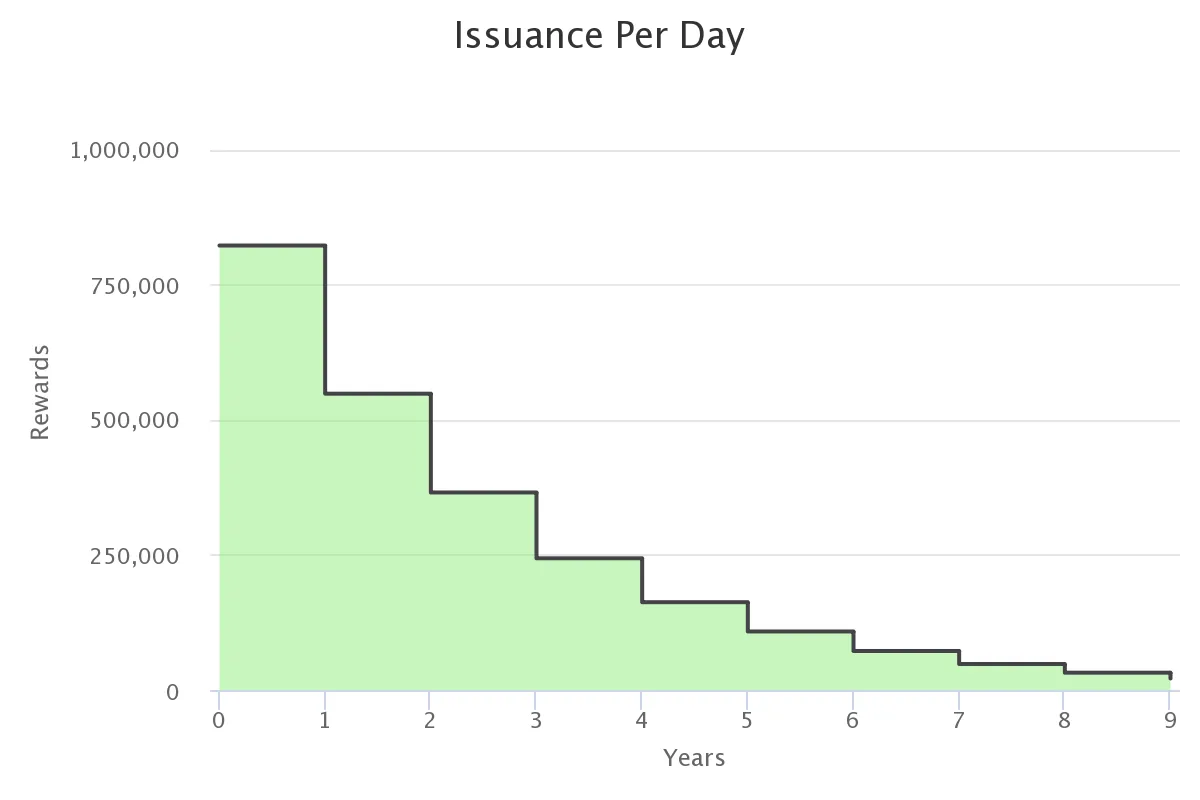
At the end of the process, $OSMO would reach a maximum supply of 1 billion. Newly released tokens would be distributed as follows: Staking Rewards – 25%, Developer Vesting – 25%, Liquidity Mining Incentives – 45%, and Community Pool – 5%.
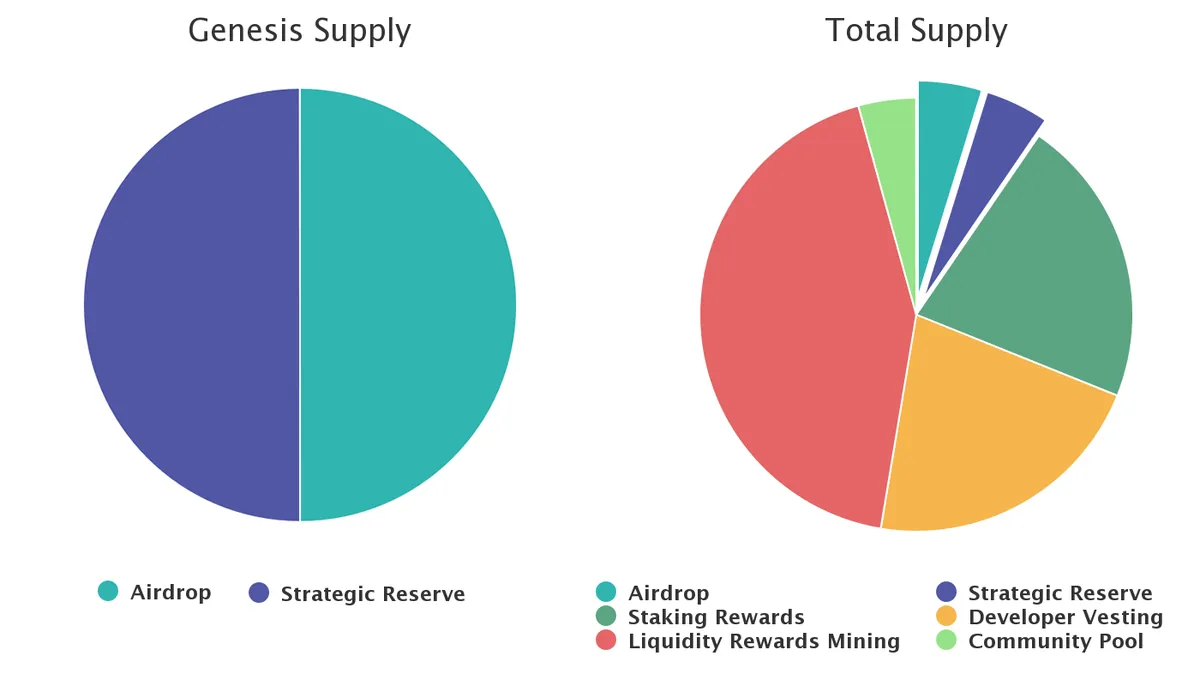
The fairdrop would be distributed through the following function based on the snapshot taken during February 18, 2021 in Cosmos. The amount each address receives is proportional to the square root of its $ATOM balance with a special 2.5x multiplier for staked atoms.

One of the currently implemented incentives is for the liquidity mining. 45% of daily issuance goes to Bonded Liquidity Gauges which is distributing liquidity incentives to LP tokens that have been bonded for a certain period of time.
Currently, the TVL in $OSMO is $1.54B, in comparison $AAVE is $19.35B, $CRV is $19.04B, and $MKR is $15.65B.
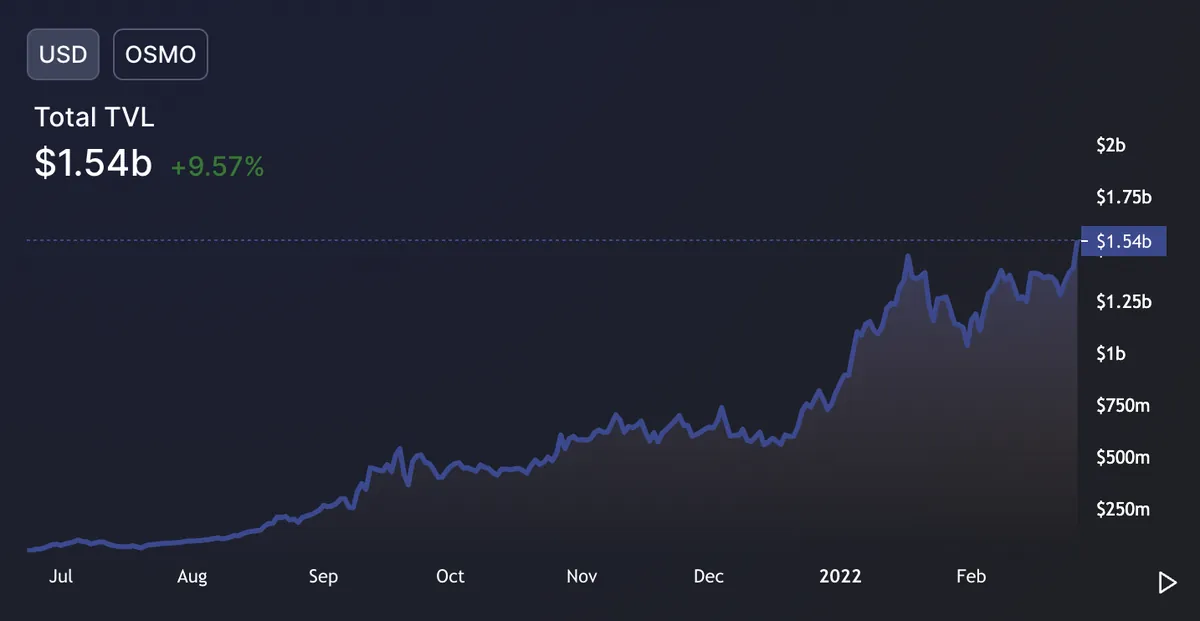
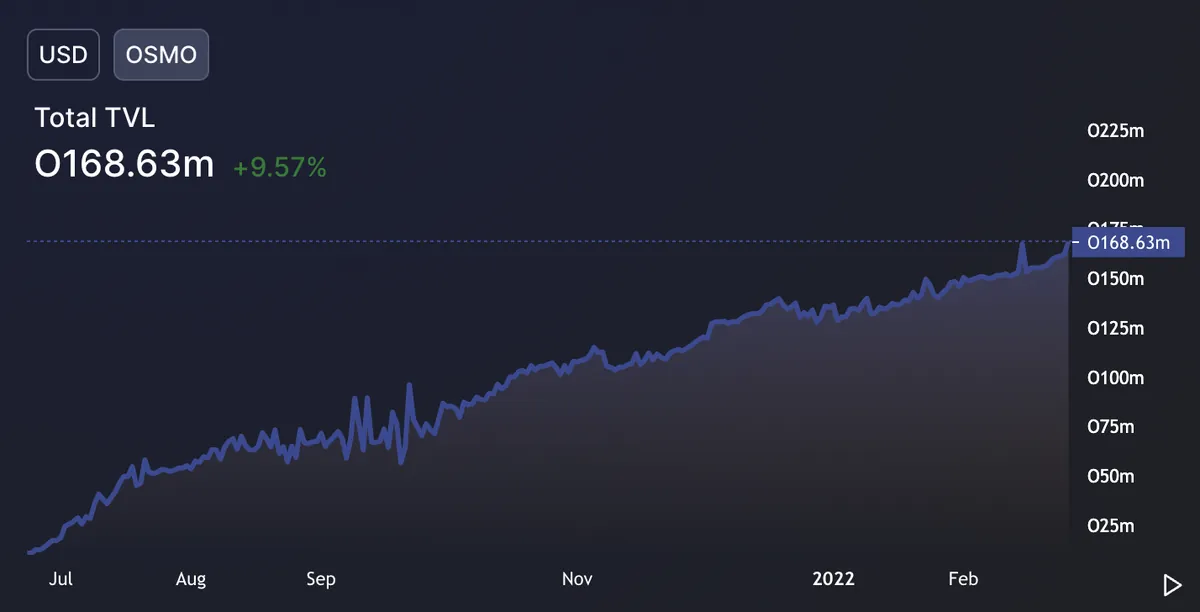
There are 600+ incentivized pools with the highest liquidity being $ATOM/$OSMO $518M and the APR is 77.19%.
Roadmap:
Though there is no set roadmap available, enthusiasts could see their github page be updated! The recent innovation was Through @AltheaNetwork Gravity Bridge, branch to non-IBC enabled chains, BTC chain, alternative smart contract platforms (custom pegs).