archive
Why DCA Matters in Crypto
Though cryptocurrency has its similarity with its traditional counterpart – stocks, it generally is not backed by any intrinsic physical asset. Its valuation is mainly derived from the token economics, which leads to pure supply and demand market performance. Furthermore, social media often causes price fluctuations, for better or worse. This indicates that cryptocurrencies are by far more susceptible to volatility than traditional markets.
Most long-term investors have implemented a strategy called Dollar Cost Averaging (DCA), pioneered by Benjamin Graham, in the traditional markets. The strategy holds the principle of time in the market instead of timing the market – dividing the total amount to be invested into periodical purchases to mitigate portfolio volatility regardless of price. Another alternative to DCA is HODL/lump sum, however most investors reached a consensus that the DCA provides a safe option providing low risk low reward. DCA’s main strategy involves buying the dip or buying in a recurring manner. Notice that the strategy primarily revolves around buying, not selling.
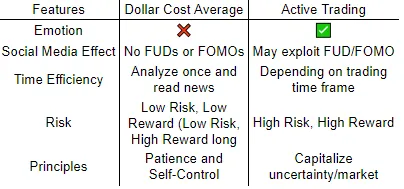
There is also much debate in the investing space regarding Dollar Cost Averaging and timing the market (actively trading). Both with its pros and cons, but DCA generally outweighs trading benefits.
The first foundation of DCA is placing emotion out of the equation. Given the social media effect on cryptocurrencies, investors are easily vulnerable to FUD (during bear markets) or FOMO (during bull markets). Dollar Cost Averaging removes all of the uncertainty or missing out under the assumption that investors have indeed personally valued the asset.
Dollar Cost Averaging approaches investing in a systematic approach. Initially, investors could set up an investing plan using a top-down or bottom-up method in valuing the asset or another type of valuation entirely. DCA is merely the plan of execution across several periods of time and compels the investor to follow with the initial plan.
Time efficiency in the crypto space is crucial considering its fast-paced nature. Leveraging DCA, investors do not need to worry about meticulous planning of each trades/transaction per week, similar to that of active traders. Hence, investors that have a 9 - 5 or day job could still enter the investing market. After valuing the asset systematically, all that matters is reading the news and following the initial plan. The valuation would not abruptly change because of outside opinions anyway right?
DCA investors could be declared as risk-averse. A sharp downturn should not affect DCA investors that deeply, instead it should be welcomed since cost averaging down would be beneficial. Thereby, reducing the long-term risk of an asset by lowering its average value in the portfolio.
A clear example, an investor approaches $BTC in late 2017 when the price is at $15,000, the start of the bull run. The investor values Bitcoin to be at least $100,000 with reasons as follows: given the asset adoption, more implementations in the physical world, the Metcalfe’s law – value of a communication network is $n^{2}$ (n is the number of users), driving an exponential factor – essentially more people means higher value, and linear regression of Bitcoin asset price close to be 1:1 to that of gold. The investor’s chose the plan of execution to only sell when the price has reached $100,000 and buy when the asset rises or falls 20%. In late December 2017, the bull run started and the investor bought at the top; then the week after it instantly turned into bear with a following of flat performance. The investor should not be worried about FUD here, since his plan was to buy BTC each time there is a 20% change in the asset. For the years 2018 to 2020, BTC trades in a price interval of 300%. By the moment another bull run starts in mid-2020, the investor should already have a floating profit provided that he follows his initial plan.
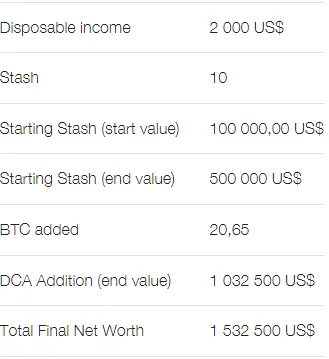
Another Example of DCA with $2,000 monthly invested (source: altcointrading.net)
Those who benefit from Dollar Cost Averaging are actually not seasoned investors, but instead teenagers who are entering the investing space. DCA does not only provide a safer risk-averse method in investing, but also teaches several principles to new investors, such as several doctrine from the Bushido code: self-control and loyalty. Teen investors would develop a sense of composure and patience to disregard all enticing fast-money options – trading; they are also urged to be loyal to one’s initial plan and not deviate from it. Teenage investors are also directed to be responsible in managing their personal finance, in which to allocate a % of their income to invest regularly.
Written by Stanley Tejakusuma